

Austrian model for digital competence - DigComp 3.0 AT
Structure of the Competency Model
-
5
Competency areas
-
21
Competences
-
8
Proficiency levels
-
522
Learning outcomes
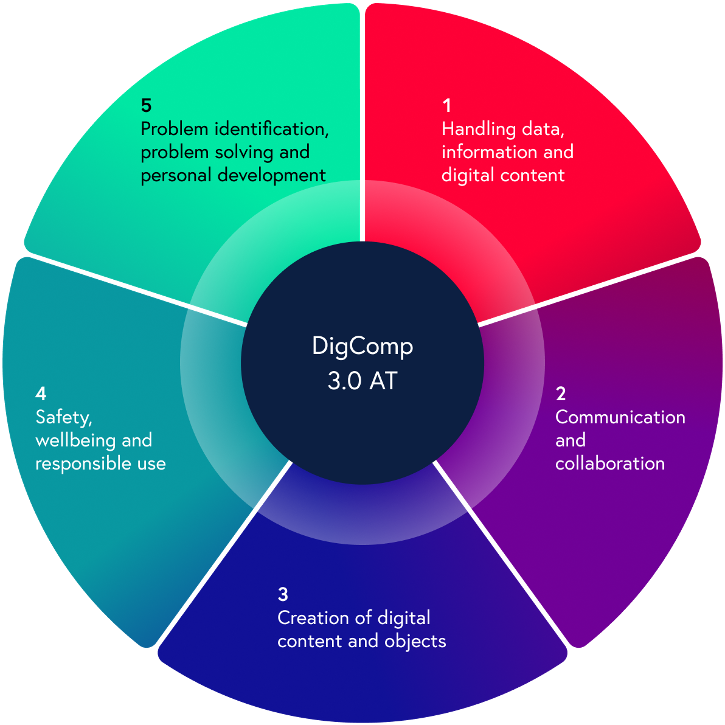
Competence areas
The Austrian DigComp 3.0 AT model provides an overview of digital competencies. To this end, it is divided into competency areas that are based on those of the EU model.
Competency Area 1 encompasses the formulation of information needs as well as the search, discovery, and retrieval of digital data, information, and content. It also includes the storage, management, organization, and analysis of digital information, as well as the critical evaluation of digital sources, data, content, and the methods used to create them.
Competency Area 2 focuses on respectful and appropriate communication in digital environments, as well as interaction, content sharing, and collaboration—always taking various aspects of diversity into account. It includes using digital technologies to participate in society, exercise one’s rights, and make decisions, as well as shaping one’s own digital presence, identity, and reputation.
Competency Area 3 refers to the creation of digital content and objects, the editing and enhancement of information and content, and their integration into existing bodies of knowledge. It also includes the application of copyright law and licenses, as well as the responsible and ethically informed handling of digital content and objects. In addition, this area encompasses computational thinking and the use of programming techniques to give instructions to digital systems.
Competency Area 4 covers the protection of devices, content, personal data, and privacy in digital environments. This area also focuses on promoting physical, mental, and social well-being and takes into account the benefits and risks of digital technologies for well-being and social participation. Other aspects of this competency area include understanding the environmental impacts of digital technologies and their use, taking steps to reduce these impacts, and using digital technologies to promote sustainability.
Competency Area 5 encompasses the recognition and assessment of needs, as well as the targeted use and adaptation of digital technologies and environments to meet those needs. This area includes identifying and solving technical and conceptual problems, as well as using digital technologies to optimize processes and products or to develop new solutions. Developing the skills to operate independently in digital environments and staying informed about developments in digital technologies are also part of this competency area.
Competencies
The five areas of competence are divided into a total of 21 individual competencies:
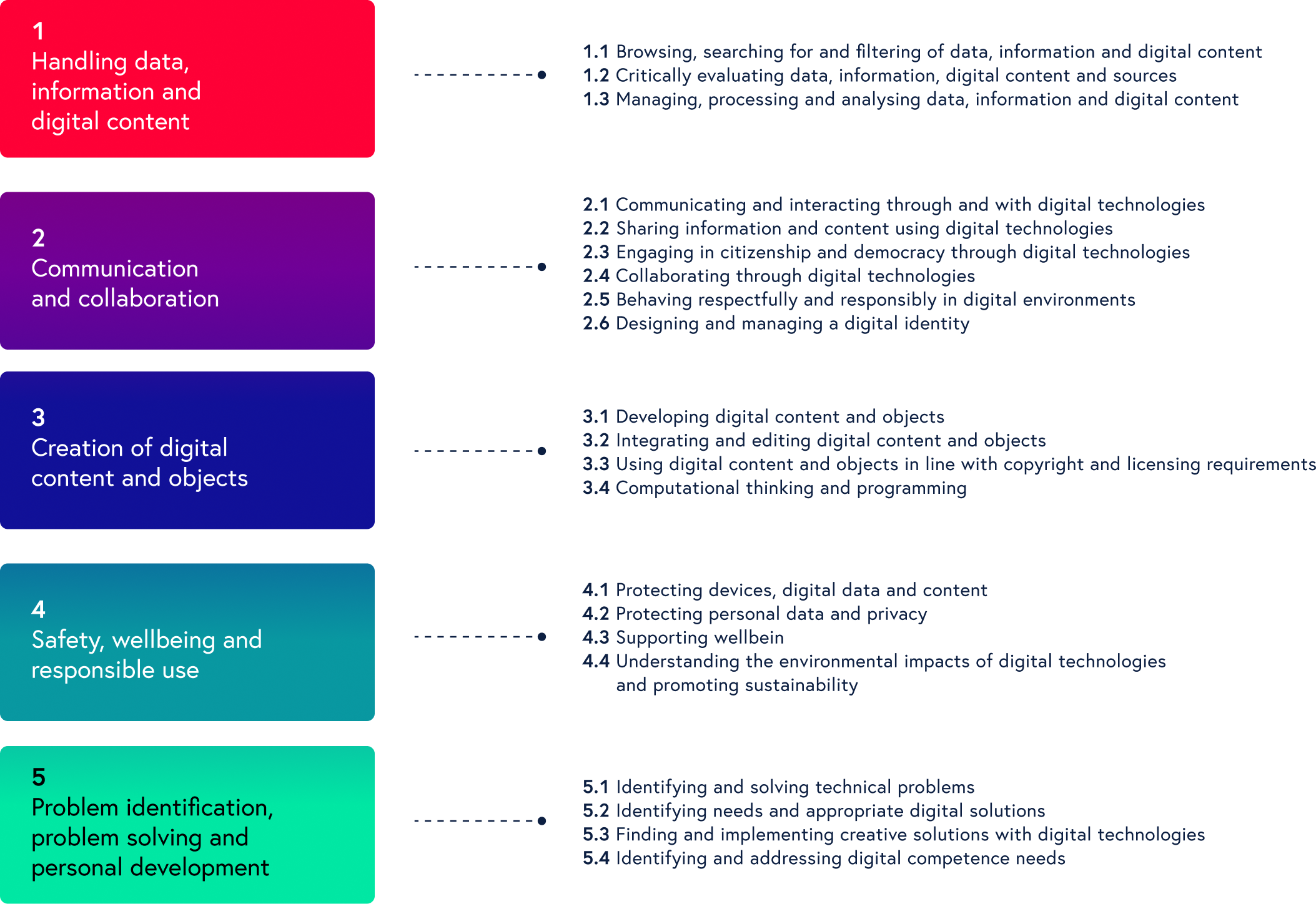
The five competence areas and their corresponding specific competences of DigComp 3.0 AT.
© CC BY ND Digital AustriaProficiency levels
The five competency areas and 21 individual competencies define the breadth of the field of digital competencies; the level of proficiency—that is, the depth of each competency—is described by a total of eight competency levels.
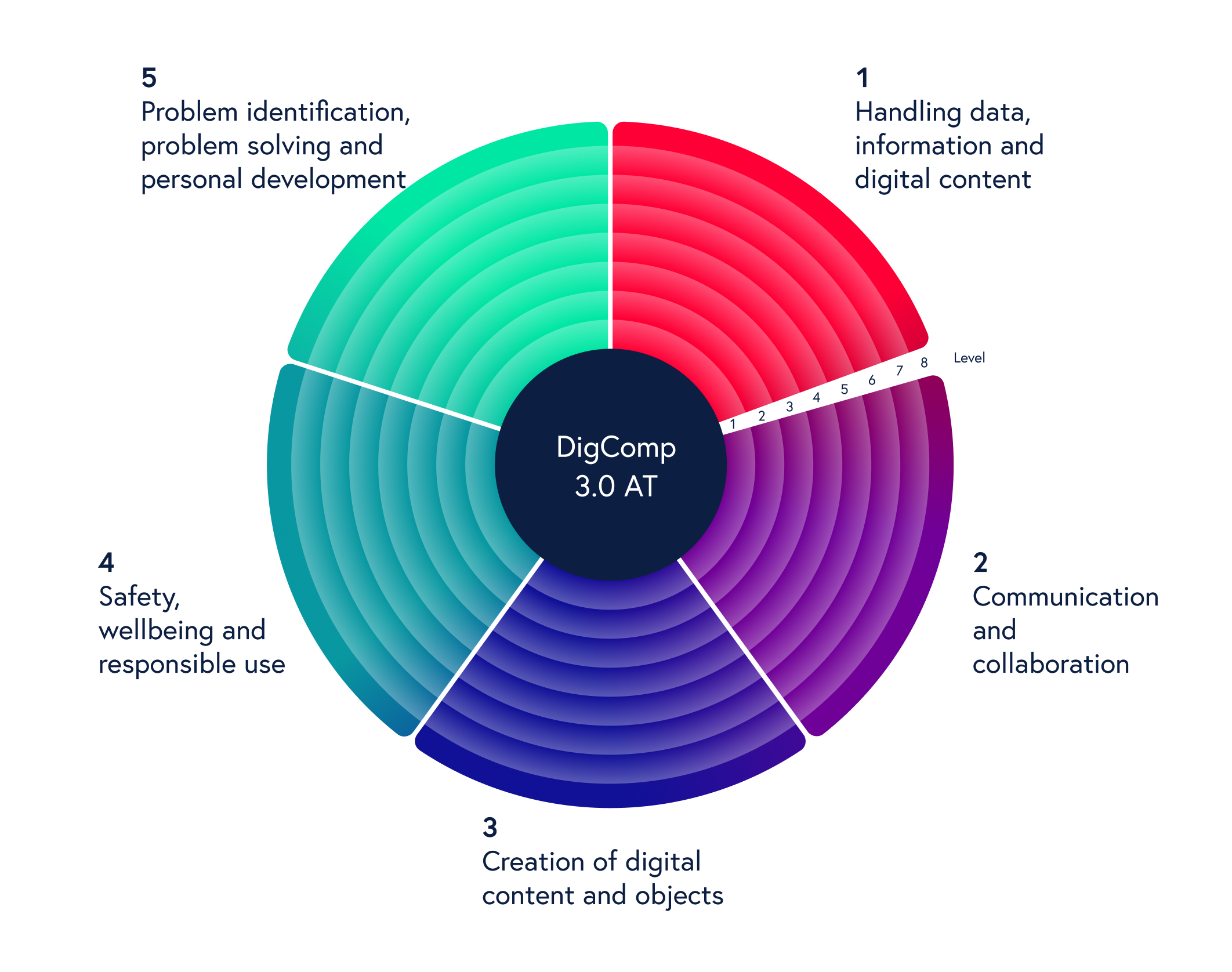
The five competence areas an the eight proficiency levels of DigComp 3.0 AT.
© CC BY ND Digital AustriaEach of the five competency areas is divided into eight competency levels. Using Competency Area 3 — Design of Digital Content and Objects — as an example, this looks as follows:
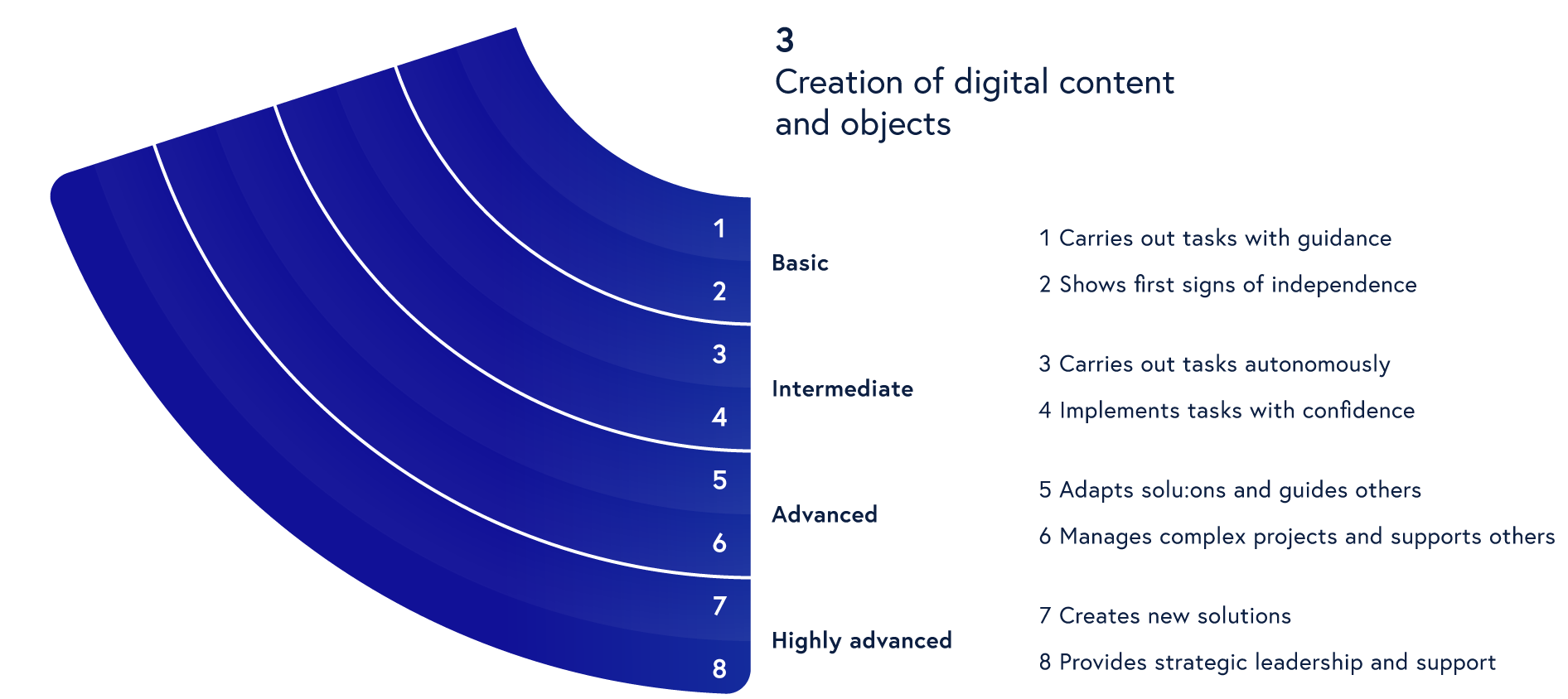
DigComp competence area detail
© CC BY ND Digital AustriaIn addition to this eight-level structure, the European DigComp 3.0 model introduces a four-level subdivision as a reference framework. This is achieved by grouping two competency levels together. Below are the descriptions for both the four-level and eight-level systems:
A person recognizes simple tasks and carries them out (with guidance as needed).
1. Carrying out tasks with guidance
A person has basic knowledge and fundamental skills and can complete simple tasks with direct guidance.
2. Demonstrating initial independence
A person remembers simple tasks and carries them out with little or no guidance.
A person identifies clearly defined tasks, carries them out independently, and solves clearly defined problems on their own.
3. Performing Tasks Independently
A person demonstrates a certain degree of independence in identifying clearly defined tasks, carrying them out, and solving clearly defined problems.
4. Handling tasks with confidence
An individual identifies clearly defined tasks, handles them confidently and independently, and solves clearly defined problems.
An individual evaluates solutions and applies them independently to a wide range of complex tasks. They adapt their approach to different circumstances in order to assess and carry out tasks appropriately. They provide guidance to others as needed.
5. Adapting Solutions and Providing Guidance to Others
An individual evaluates and applies solutions to a wide range of clearly defined tasks and handles tasks that are sometimes complex. They identify situations in which procedures need to be adapted and provide guidance to others on clearly defined tasks as needed.
6. Managing Complex Projects and Supporting Others
An individual confidently handles a wide range of complex tasks and responds effectively to challenges under changing conditions. They lead or manage complex projects and provide guidance to others on complex tasks as needed.
A person analyzes, evaluates, and solves highly complex or specialized problems to develop new solutions or adapt existing ones. They lead and guide others as needed.
7. Developing New Solutions
An individual analyzes highly complex or specialized problems and contributes to the development of new solutions or adapts existing ones. They guide and support others as needed.
8. Strategic Guidance and Support
An individual guides and supports others in developing solutions to highly complex or specialized problems.
Learning Outcomes
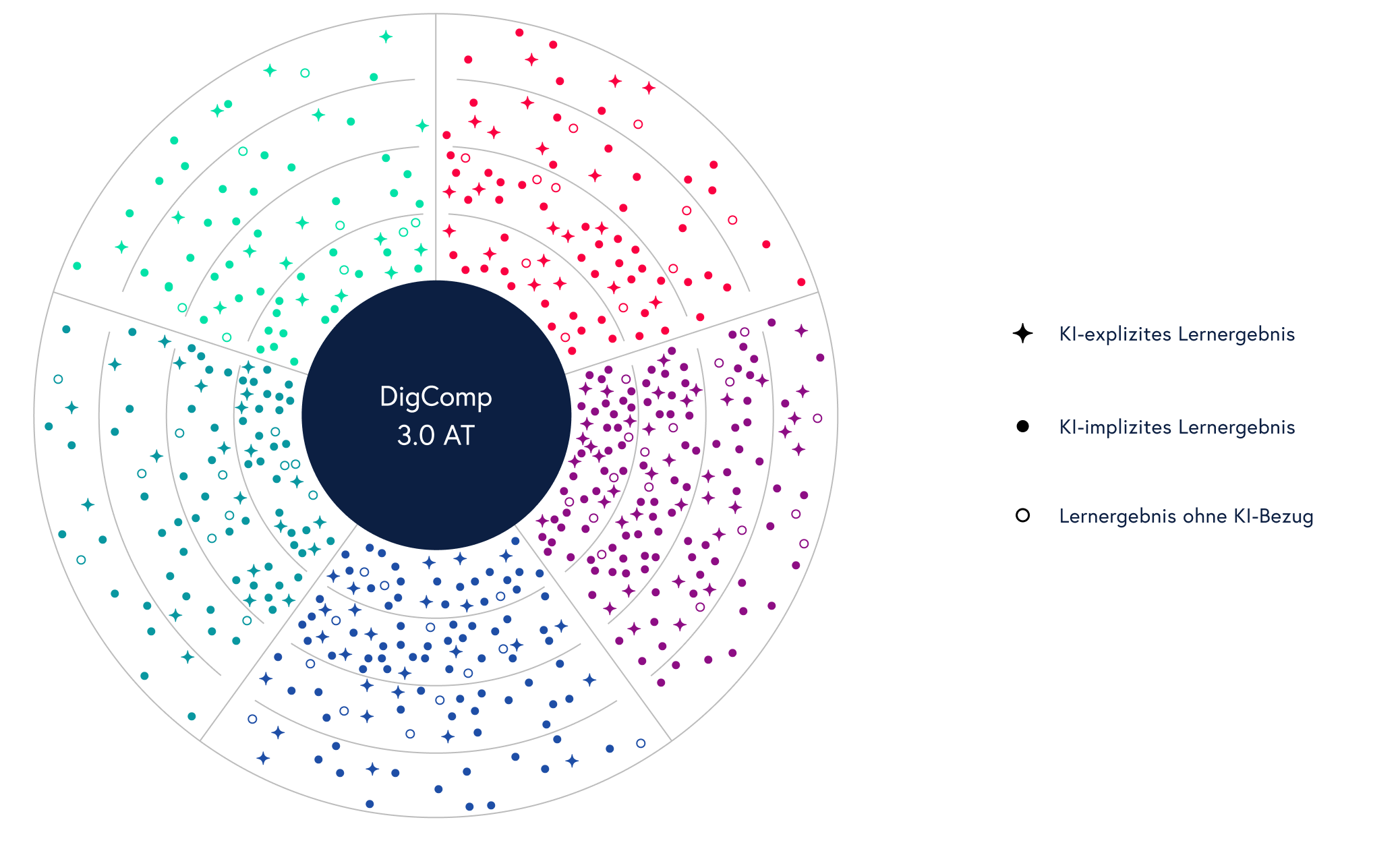
The Austrian DigComp model gains a new structural element with the release of DigComp 3.0 AT: With over 500 detailed learning outcomes, the competency areas and individual competencies are defined more precisely in terms of content, enabling the competency model to be easily operationalized in educational practice.
AI competencies are also made visible through the level of learning outcomes:
- Explicit AI learning outcomes: relate directly to the use of artificial intelligence
- Implicit AI learning outcomes: relate to general digital competencies necessary for the competent use of artificial intelligence
- Learning outcomes not related to AI
Download DigComp 3.0 AT


